
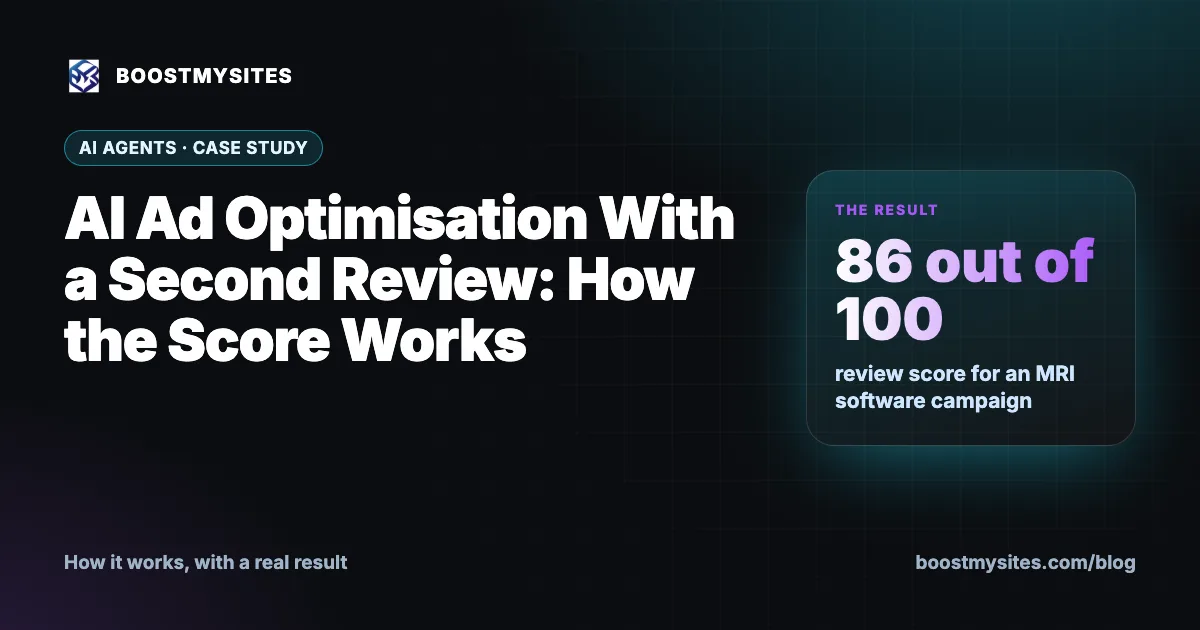
AI ad optimisation works best when one AI improves the campaign and a second, separate AI checks the work. At BOOSTMYSITES every campaign goes through these two passes, and the review gives it a score out of 100. In this case study, an MRI software company's WhatsApp engagement campaign scored 86 after the review removed a claim the founder had never made.
At a glance
| Service | AI ad optimisation with a second review |
|---|---|
| Who it is for | Businesses running Meta or Google ads who want each campaign improved and checked |
| Case | An AI radiology (brain and spine MRI) software company |
| Period | November 2026 |
| Result | WhatsApp engagement card scored 86 out of 100 after the review removed an unsupported claim |
What AI ad optimisation is
Optimising an ad means making it better at its job: reaching the right people, saying the right thing and asking for the right next step. For a business owner, the hard part is not knowing what to change. Is it the audience? The wording? The form? The picture?
AI ad optimisation does this work for you. But one AI checking its own work has the same weakness as a person checking their own writing: it misses its own mistakes. So at BOOSTMYSITES the work is split into two passes.
In the first pass, the optimiser rewrites the campaign. It can change the audience, the wording and the form, but it keeps the budget the owner set. In the second pass, a separate review, which we call the "head of performance", scores the campaign out of 100 against a fixed list of checks:
- Facts only. Every claim must come from the client's facts.
- Warnings true. Any warning shown to the owner must be correct.
- Client brief followed. The campaign must match what the owner asked for.
- Top 1% sign-off. The campaign must meet a top 1% standard before the review signs it off.
How it works, step by step
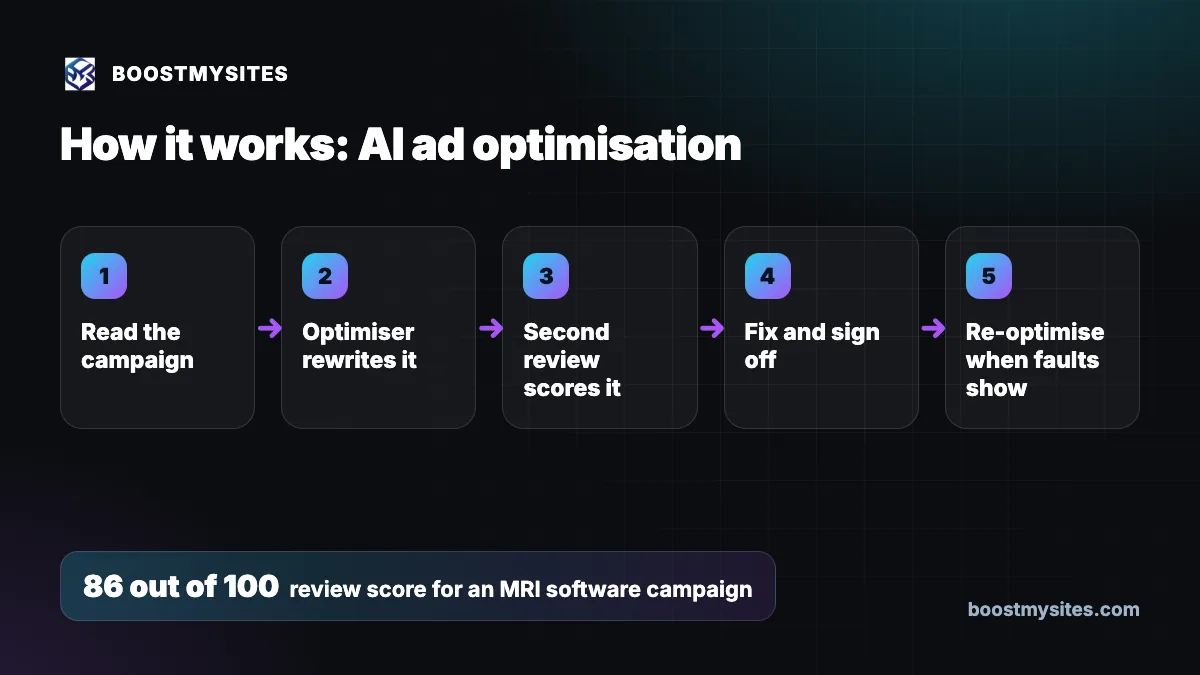
- Read the campaign The optimiser reads the campaign card, the client's brief and, for a live ad, its report.
- Optimiser rewrites it The audience, wording and form are improved, and the budget is kept as the owner set it.
- Second review scores it A separate "head of performance" review scores the result out of 100 against the checks.
- Fix and sign off Anything that fails a check, such as a claim not in the brief, is removed before the owner sees it.
- Re-optimise when faults show Live ads are re-optimised at most every 3 days, and only when the report shows a fault.
Case study: an 86 out of 100 review for an MRI software campaign
The challenge
The client makes AI software for brain and spine MRI reporting. Its buyers are diagnostic centres, hospitals and teleradiology firms. In this field, what an ad claims matters a great deal. A claim that sounds good but is not backed by the company's own words can do harm to its name with exactly the buyers it wants to reach.
The company's growth plan put its budget on one campaign, a WhatsApp engagement ad, so that campaign had to be right.
What we did
The optimiser worked on the WhatsApp engagement card first, improving the audience, the wording and the form while keeping the budget. Then the head of performance review checked the result against its list.
The review found a claim that the founder's brief did not support. Under the "facts only" and "client brief followed" checks, that claim had to go, so it was removed. In our post on approval links we note that the claim was about "accuracy". Once it was removed, the card scored 86 out of 100.
The results
| Measure | Where it stands |
|---|---|
| Review score | 86 out of 100 |
| Unsupported claims | Removed by the review |
| Budget | Kept as set by the owner |
| Status | Waiting for the founder's approval |
This campaign has not run yet, so there are no lead numbers to report. What the case shows is the review working as intended: it stopped a claim from reaching buyers before the owner ever had to spot it.
The lesson
The value of a second review is in what it catches. An optimiser trying to make an ad stronger will sometimes reach for a stronger claim. A separate reviewer, judging against fixed checks, asks a simpler question: is this true, and did the owner say it? That one question protects the business.
The same thinking applies to live ads. Changing an ad every day does not give it time to show what works. So live ads are re-optimised at most every 3 days, and only when the report shows a real fault: the button, the form, the places the ad is shown or the picture.
Common mistakes this fixes
- One AI checking itself. A separate review catches what the optimiser misses.
- Claims the owner never made. The "facts only" and "client brief followed" checks remove them.
- Budget changes nobody asked for. The optimiser keeps the budget the owner set.
- Changing live ads too often. Live ads are re-optimised at most every 3 days, only when the report shows a fault.
- Fixing the wrong thing. Re-optimising starts from the fault the report shows, such as the button, form, places or picture.
Who should use it
AI ad optimisation with a second review suits any business running Meta or Google ads that wants better campaigns without risking false claims. It is especially useful in fields where accuracy matters, such as medical, education and finance, and for small business owners in India who do not have time to study ad reports. More guides are on the BOOSTMYSITES blog.
Frequently asked questions
How does AI optimise Facebook ads?
In our system, an optimiser rewrites the campaign's audience, wording and form, keeping the budget. A separate review then scores it out of 100 against fixed checks before the owner sees it.
What does the ad review score out of 100 mean?
It is the head of performance review's judgement against its checks: facts only, warnings true, client brief followed and top 1% sign-off. The MRI campaign in this case scored 86.
How often should I change my ads?
Not every day. We re-optimise live ads at most every 3 days, and only when the report shows a fault in the button, form, places or picture.
Will AI optimisation increase my ad budget?
No. The optimiser keeps the budget you set. You pay that budget directly to Meta or Google from your own account.
Can AI add false claims to my ads?
Any AI can make mistakes, which is why the review has a "facts only" check. In this case, it removed a claim that was not in the founder's brief. You also approve every ad yourself.
Want every campaign improved and then checked by a second AI? Start with BOOSTMYSITES for $1. See also the ad stop-loss that judges each ad by real leads and how an AI growth plan builds campaigns from your brief.