
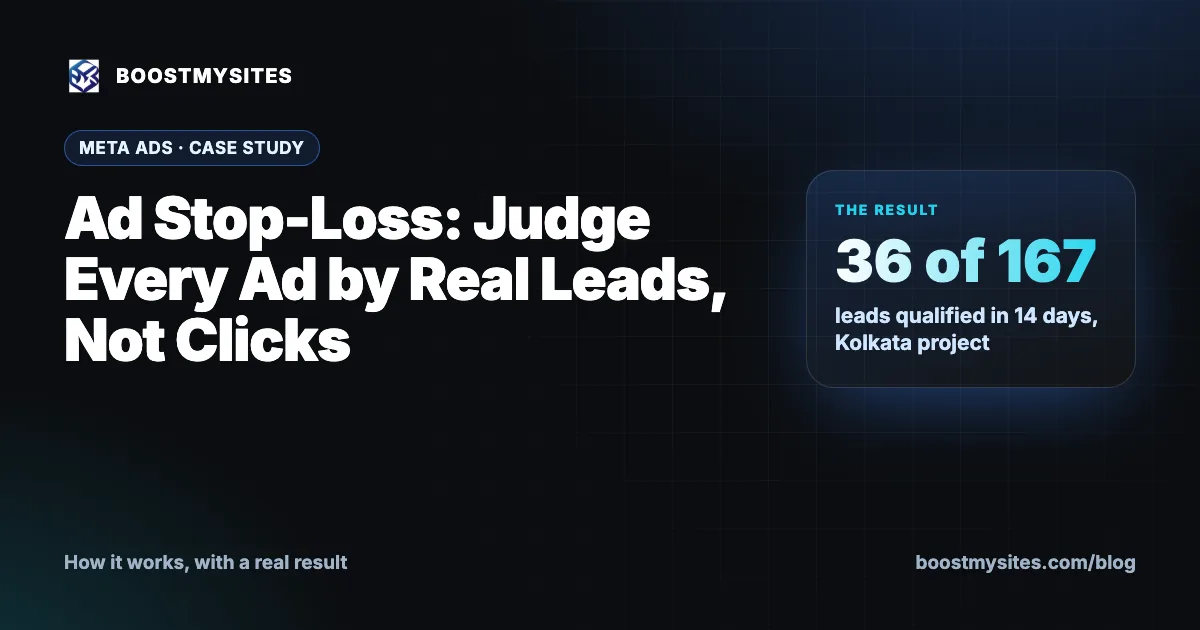
An ad stop-loss judges each ad by the real leads it brings, not by clicks or cheap form fills. A residential project in Kolkata shows why it matters: 167 leads in 14 days, but only 36 of them qualified. This post explains how the stop-loss decides which ads to stop, why some ads are never stopped, and how the owner's "good leads only" order moves money every 2 hours.
At a glance
| Service | Ad stop-loss: judging each ad by its real leads, not clicks |
|---|---|
| Who it is for | Businesses running several ads that care about lead quality, not just lead count |
| Case | A residential project channel partner in Kolkata |
| Period | 6 to 19 November 2026 (14 days) |
| Result | 167 leads, 36 qualified; standing order "good leads only", with money moved every 2 hours towards ads bringing good leads |
What an ad stop-loss is
In trading, a stop-loss is a rule that limits how much you can lose on one bet. An ad stop-loss does the same for ad money. It watches each ad and marks it for stopping when the ad keeps spending without bringing real customers.
The key word is real. Ad platforms report clicks, impressions and leads. Those numbers can look healthy while the business gets nothing useful. An ad can bring many cheap leads that turn out to be wrong numbers, people outside your area or people who never meant to buy. If you judge ads by clicks or lead count, the worst ad can look like the best one.
The BOOSTMYSITES stop-loss works differently. Every lead in the CRM is matched to the ad that brought it. Each ad is then judged on its own real leads, using clear rules.
| Mark | When it applies |
|---|---|
| STOP | The ad has spent 3 times the target cost with no real lead |
| STOP | The ad has brought 15 or more leads and 80% of them are junk |
| BLIND | The ad's leads do not reach the CRM, so there is a tracking hole. A BLIND ad is never stopped |
The BLIND rule matters. If an ad's leads are not reaching the CRM, we cannot judge it, so stopping it would be a guess. The right fix is to close the tracking hole first.
How it works, step by step
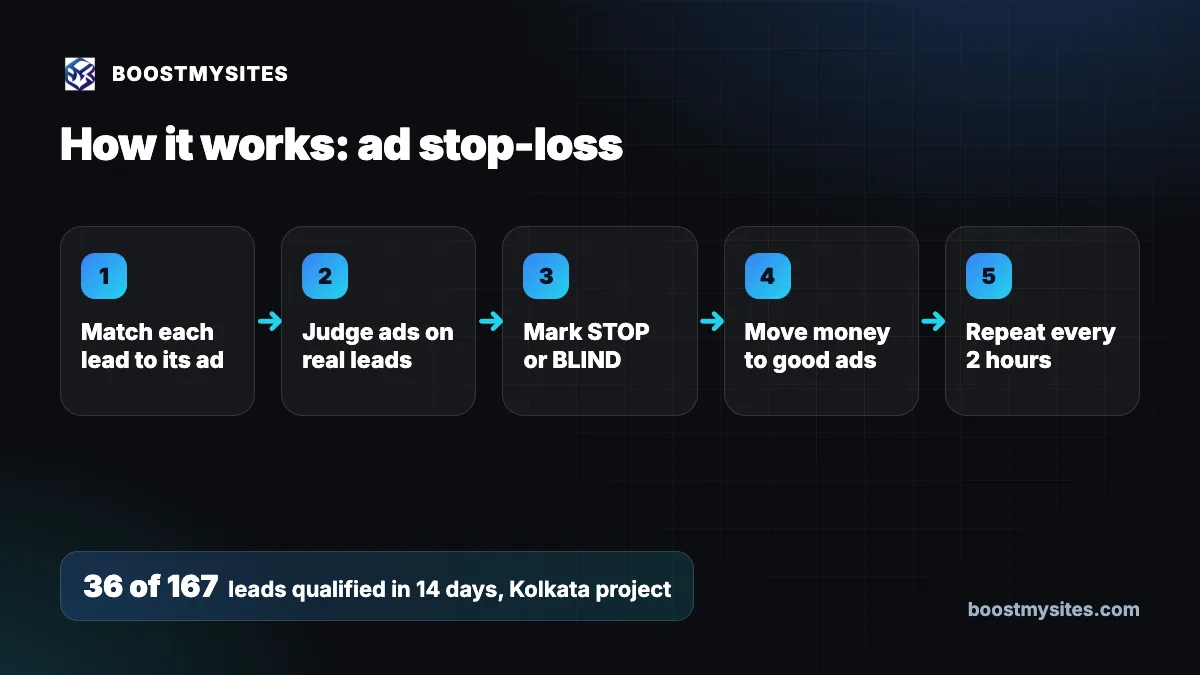
- Match each lead to its ad Every lead in the CRM is linked to the ad that brought it, so each ad has its own list of leads.
- Judge ads on real leads Each ad is measured on how many real, useful leads it brought, not on clicks.
- Mark STOP or BLIND An ad that spends 3 times the target cost with no real lead, or brings 15+ leads that are 80% junk, is marked STOP. An ad whose leads do not reach the CRM is marked BLIND and is not stopped.
- Move money to good ads Under a "good leads only" order, money moves from ads bringing junk to ads bringing good leads.
- Repeat every 2 hours The check runs again every 2 hours, so the budget keeps following quality.
Case study: why 167 leads were not the whole story in Kolkata
The challenge
The client is a channel partner selling flats in a residential project in Kolkata. Its Meta lead form ads worked, in the sense that leads came in. From 6 to 19 November 2026, the CRM recorded 167 leads, and 152 of them came from the ads. We tell the full story of that campaign in our post on Meta lead form ads for real estate.
But only 36 of the 167 leads were marked qualified. And over 100 leads were still waiting for a first call. For a seller with limited time, a big pile of leads with few real buyers in it is a problem, not a win. Every call to a junk lead is a call not made to a real buyer.
What we did
The owner set a standing order: good leads only. With that order, the aim is clear. Instead of trying to bring the most leads, it tries to bring the most good ones.
With every lead matched to its ad, the stop-loss can see which ads bring buyers and which bring junk. Every 2 hours, money is moved from the ads bringing junk to the ads bringing good leads. Ads that meet a STOP rule are marked STOP. Any ad whose leads do not reach the CRM is marked BLIND and left running until its tracking is fixed, because judging it without data would be guessing.
The results
| Measure | 6 to 19 November 2026 |
|---|---|
| Leads in the CRM | 167 |
| Leads from ads | 152 |
| Marked qualified | 36 |
| Leads waiting for a first call | Over 100 |
| Budget check | Every 2 hours, under "good leads only" |
We are not going to claim a before and after quality number we do not have. The honest result is this: the 14-day numbers showed that volume is not quality, the owner set a clear order, and the budget now moves every 2 hours towards the ads that bring good leads.
The lesson
Volume is not quality. A campaign can look busy and still waste most of its money. The fix is to judge each ad by its own real leads, stop the ones that only bring junk, and never stop an ad just because its data is missing. When the owner says "good leads only", the system should follow that order every few hours, not once a month.
Common mistakes this fixes
- Judging ads by clicks. Clicks are not customers. Each ad is judged by its real leads.
- Keeping junk ads alive. An ad with 15+ leads that are 80% junk is marked STOP.
- Paying for nothing. An ad that spends 3 times the target cost with no real lead is marked STOP.
- Stopping ads on missing data. A BLIND ad, whose leads do not reach the CRM, is never stopped. The tracking hole is fixed instead.
- Moving budget once a month. Under "good leads only", money moves every 2 hours.
Who should use it
An ad stop-loss suits any business running more than one ad, especially where lead quality varies a lot, as it does in real estate, education and services in India. It needs good lead tracking to work, because every lead must be matched to its ad. If you are not sure your leads are all reaching one list, start with a lead tracking CRM for every source. More guides are on the BOOSTMYSITES blog.
Frequently asked questions
How do I know which Facebook ad brings junk leads?
Match every lead to the ad that brought it and mark which leads are real. Then you can compare ads by real leads, not clicks.
When should I stop a Facebook ad?
Our rules mark an ad STOP when it spends 3 times the target cost with no real lead, or brings 15 or more leads that are 80% junk.
Why are some ads never stopped?
If an ad's leads do not reach the CRM, it is marked BLIND. We cannot judge it without data, so we fix the tracking first instead of stopping it.
How often should ad budget move between ads?
For the Kolkata project, under the owner's "good leads only" order, money is moved every 2 hours from ads bringing junk to ads bringing good leads.
Is more leads always better for real estate ads?
No. The Kolkata project had 167 leads in 14 days, but only 36 were qualified. What matters is how many real buyers the ads bring.
Want your ad money judged by real leads, not clicks? Start with BOOSTMYSITES for $1. Read next how AI ad optimisation with a second review improves each campaign and how a WhatsApp AI agent contacts every lead in seconds.